XOT to XOT Router
XOT to XOT Router (attempt 1)
I have built a small collection of hardware and software for exploring X.25 networking. It contains routers, interfaces and bridges from the 1990s through to the early 2020s.
Welcome to my Lab has an introduction to the various devices discussed below.
The Problem
Having an XOT to XOT router would be very useful. Imagine you are virtualising X.25 workloads, which requires replacing physical serial interfaces with XOT connections. Having a router accept inbound XOT from your (now virtual) workload and send it on to the appropriate destination (based on destination X.121 address) enables you to centralise X.25 routing on the router, rather than within each workload.
In my experience, Cisco routers will not connect incoming X.25 over TCP (XOT) calls to outbound XOT destinations.
Goals
Xotd can bridge traffic from a local TUN interface out over XOT, and it can also accept XOT connections and bridge calls to the TUN interface. It seems like xotd would be a good tool for creating an XOT to XOT router.
Based on a rudimentary understanding of xotd, there are two ways that this might work:
- XOT to XOT using multiple xotd instances.
- XOT to XOT using one xotd instance.
It turns out that neither works out of the box. The reason is the same for both, and can be overcome.
XOT to XOT using multiple xotd instances
In Linux X.25 and XOT I built and configured xotd with a single peer. You will want to complete that article first before reading this one.
Routing
Running multiple copies of xotd will give us a 1:1 mapping of xotd to TUN interface, which is simple to envision.
We should be able to use Linux’s X.25 routing to move traffic between them. We can enable this with:
sysctl net.x25.x25_forward=1To tell Linux which interface is associated with which X.121 address prefix we will use the Linux net-tools route command. It accepts an X.121 address prefix and mask (number of digits).
I modify the interface script /usr/local/sbin/xotd-setup to route the prefixes to the TUN interfaces:
#!/bin/sh -e
echo "Setting up $1" > /dev/console
ip link set "$1" up
case "$1" in
    "tun0")
        route --x25 add 701/3 "$1"
        ;;
    "tun1")
        route --x25 add 702/3 "$1"
        ;;
esac
Xotd for Destinations in 701/3 and 702/3
Configuring TUN0 and TUN1
I then create configuration files to configure my two xotd instances to manage tun0 and tun1:
/usr/local/etc/xotd-tun0.conf
tun0 192.0.2.250 /usr/local/sbin/xotd-setup 256/usr/local/etc/xotd-tun1.conf
tun1 192.0.2.248 /usr/local/sbin/xotd-setup 256And attempt to start xotd:
/usr/local/sbin/xotd -v -f /usr/local/etc/xotd-tun0.conf
/usr/local/sbin/xotd -v -f /usr/local/etc/xotd-tun1.conf
Allowing multiple xotd instances
Only one xotd instance starts, and the logs show:
Apr 11 09:58:02 xotd[19440]: Error binding socket: Address already in useThis is caused by xotd binding all interfaces in xotd.c:
    addr.sin_family = AF_INET;
    addr.sin_port = htons (lport);
    addr.sin_addr.s_addr = htonl (INADDR_ANY);

    if (bind (sock, (struct sockaddr *) &addr, sizeof addr) == -1) {
So I modify xotd.c to accept a bind address argument:
    addr.sin_family = AF_INET;
    addr.sin_port = htons (lport);
    if (inet_pton(addr.sin_family, bindaddr, &(addr.sin_addr)) <= 0) {
        printd ("Invalid local address '%s': %s", bindaddr, strerror(errno));
    }

    if (bind (sock, (struct sockaddr *) &addr, sizeof addr) == -1) {
And start xotd. We don’t have to worry about the bind addresses right now, so we will use localhost addresses:
/usr/local/sbin/xotd -v -b 127.0.0.10 -f /usr/local/etc/xotd-tun0.conf
/usr/local/sbin/xotd -v -b 127.0.0.11 -f /usr/local/etc/xotd-tun1.conf
We can now see that /usr/local/sbin/xotd-setup set up our requested routes:
route --x25
Kernel X.25 routing table
Destination          Iface
702/3                tun1
701/3                tun0
Configuring a third xotd
When we attempt a call using xotpad the xotd logs show call from unknown address 127.0.0.1. We will also need another xotd instance to accept our incoming calls, since the IP address in the xotd configuration file is used to both:
- Provide the destination IP address for outbound calls.
- Filter incoming calls (matching source IP to TUN devices).
/usr/local/etc/xotd-tun2.conf
tun2 127.0.0.1 /usr/local/sbin/xotd-setupAfter modifying /usr/local/sbin/xotd-setup to add a route for 127/3, I bring up another xotd on tun2, our X.25 routes now look like this:
route --x25
Kernel X.25 routing table
Destination          Iface
127/3                tun2
702/3                tun1
701/3                tun0
Attempting a connection
Connecting to the tun2 xotd using xotpad results in an error:
xotpad -g 127.0.0.12 -a 127001 701001||stty sane
Error: Custom { kind: ConnectionReset, error: "C:1 D:0" }
Using x25-utils x25trace, we can see that Linux is replying with a Clear Confirmation message. The kernel doesn’t seem to think it has anywhere to send this traffic:
Port: tun2
X.25: LCI 0FF : CALL REQUEST - 127001 -> 701001
Packet Size:     07 07
Window Size:      2  2
0000  01 00 00 00                                      | ....

Port: tun2
X.25: LCI 0FF : CLEAR CONFIRMATION
pad_svr test
At this point we think that the problem is that Linux doesn’t have something to send the packets to. We can test that theory using pad_svr. We previously used pad_svr in Linux X.25 and XOT.
/etc/pad_svr/pad_svr.cfg is modified to expect calls on 701999:
/etc/pad_svr/pad_svr.cfg
local_x121_address 701999
log_level 5
log_path /var/log/pad_svr.log
Watchdog_timeout 10
Winsize_in 2
Pacsize_in 128
Forward_idle_timeout 1
x29_profile 1:0,2:0,3:0,4:1,13:4,15:0 Buffer_size 32000
With pad_svr up and running, /proc/net/x25/socket shows that Linux has associated it with 701999 (but interestingly has not associated it with a particular TUN device):
cat /proc/net/x25/socket
dest_addr  src_addr   dev   lci st vs vr va   t  t2 t21 t22 t23 Snd-Q Rcv-Q inode
*          701999     ???   000  0  0  0  0   0   3 200 180 180     0     0 49719
Using xotpad we can make a call to pad_svr:
xotpad -g 127.0.0.12 -a 127001 701999 ||stty sane
Debian GNU/Linux 13

thread 'x25_vc_1' panicked at libxotpad/src/x25/vc.rs:817:57:
not yet implemented
The “Not yet implemented” seems to be due to Linux setting the Q bit on a packet to xotpad. We won’t worry about that for now.
XOT to XOT using one xotd instance
Examining the source code, the xotd configuration file accepts multiple lines, with one interface and peer per line. For example:
/usr/local/etc/jh-xotd.conf:
# Routers
tun0 192.0.2.250 /usr/local/sbin/xotd-setup 256
tun1 192.0.2.248 /usr/local/sbin/xotd-setup 256
# Clients
= 192.0.2.34 /usr/local/sbin/xotd-setup
This allows us to run a single xotd to manage multiple TUN devices, we can probably use this instead of running multiple xotd instances.
The benefit of multiple instances is flexibilty, we can add and remove peers without interrupting existing sessions.
However, this config also fails XOT/XOT in the same way as when we run multiple xotd instances.
Summary
xotpad can connect to pad_svr because pad_svr has a listening socket (which isn’t associated with a particular TUN):
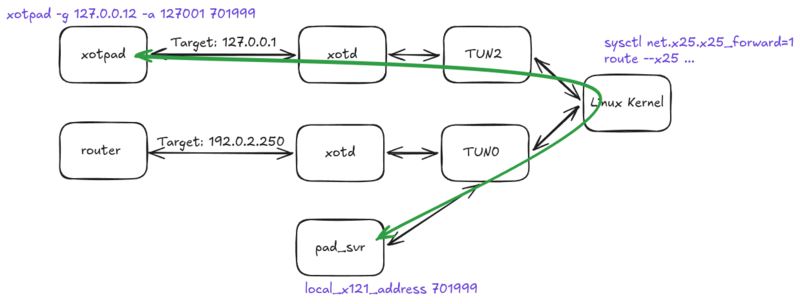 xotpad to pad_svr
Linux routes calls made with connect() to the correct xotd (e.g. calls generated with x25_client)
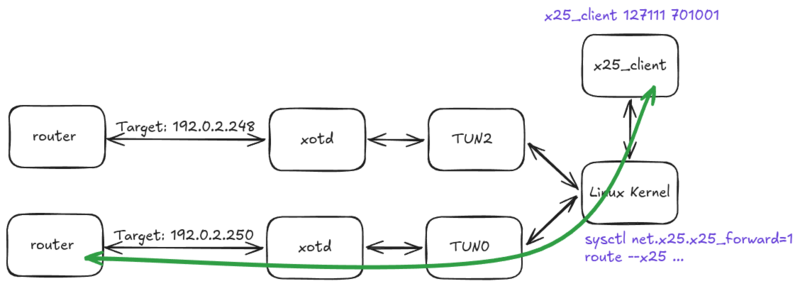 x25_client to router
Since xotpad uses writev to inject packets directly onto a TUN device based on the callers IP address, and xotpad has no listening socket, Linux has no opportunity to route XOT to XOT packets.
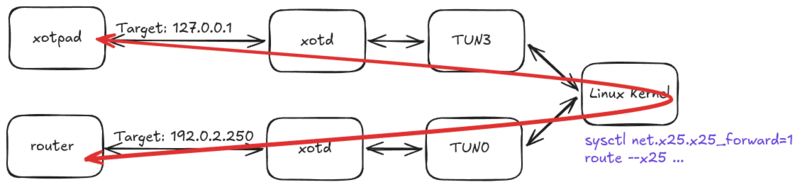 XOT to XOT fails
This seems to be an architectural issue. xotd shuttles packets back and forth, with minimal inspection of the packet contents. This works well for X.25 to XOT (where routing occurs before xotd is involved) and for XOT to X.25 (where routing does not matter since listening sockets aren’t associated with TUN devices). It fails, however, when xotd delivers packets to the wrong TUN for their X.121 address.
Some possible solutions would be to:
- Have xotd listen() for each address range associated with each TUN. This might resolve the XOT to XOT use case, however it will probably interfere with the XOT to X.25 use case?
or:
- Perform routing within xotd. xotd has no concept of destination addresses, which prevents it from routing packets to a TUN that might be able to handle them. Adding destination addresses and routing to xotd might solve our issue.
- This seems like a bad option. Adding routing to xotd would duplicate functionality that is already available in Linux, in a way that would be surprising to the user (since
route --x25would be inaccurate).
- This seems like a bad option. Adding routing to xotd would duplicate functionality that is already available in Linux, in a way that would be surprising to the user (since
or:
- Reimagine xotd as parts with cleaner definitions:
- xot_listener to accept XOT connections and connect() to the X.25 subsystem.
- xot_connect to listen() and accept() X.25 connections for specific address ranges and originate outbound XOT sessions.
- xot_dns to listen() and accept() X.25 connections to unknown address ranges, do DNS lookups to discover routes and run new xot_connect instances to hand off the connections to (similar to inetd).
I think I like the last option best.